Can Clear Well Water Still Be Unsafe to Drink?
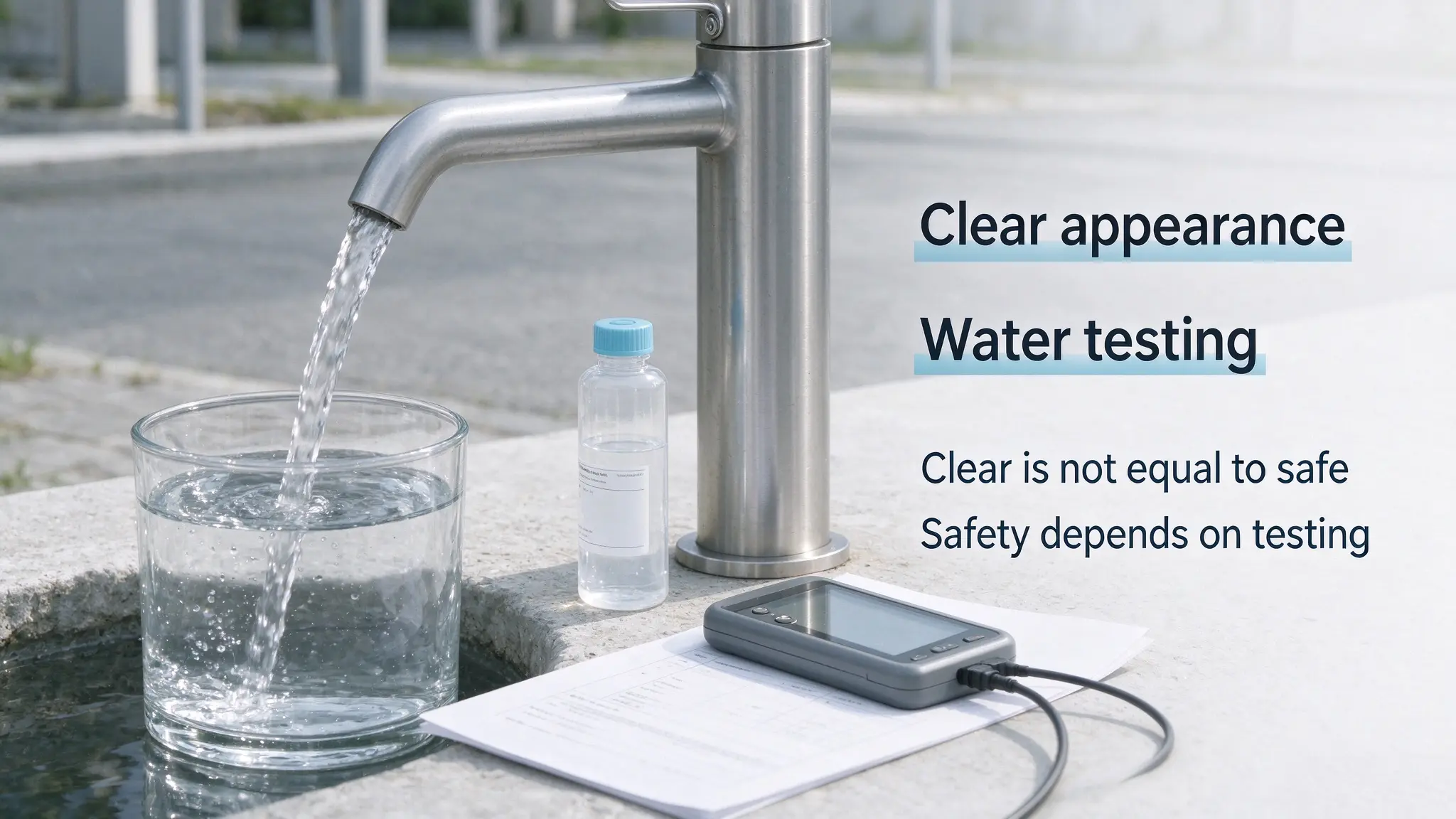
A glass of clear, odorless well water can look reassuring. However, appearance does not establish whether it is suitable for drinking.
Some microbial and chemical contaminants do not noticeably change water’s color, taste or smell. Laboratory testing is the reliable way to identify these problems and decide whether treatment is needed.
For a home, farm, hotel or other facility using a private well, water quality should be assessed before selecting filtration equipment.
What Can Water Appearance Tell You?
Changes in appearance are useful clues. Cloudiness, discoloration or sediment can indicate that the water supply needs investigation.
However, these observations have limits:
Observation | What It Can Tell You | What It Cannot Confirm |
Clear water | No obvious visible particles or color | Absence of dissolved contaminants or microorganisms |
No unusual smell | No noticeable odor at the time of observation | Compliance with drinking-water requirements |
No visible staining | No obvious staining under current conditions | Absence of iron or manganese |
Improved appearance after filtration | The treatment has changed a visible characteristic | Removal of every contaminant of concern |
Treat appearance as a reason to investigate, rather than a substitute for testing.
Does a Low TDS Reading Mean the Water Is Safe?
No. A handheld TDS meter is useful for monitoring general changes in dissolved ionic content, but it does not identify individual contaminants.
A TDS reading cannot replace a bacteria test, a lead test or a laboratory analysis for specific dissolved substances. CDC includes TDS alongside other well-water tests, rather than treating it as a complete safety assessment.
When reviewing equipment, avoid using a low TDS reading as the sole proof that treated water is safe.
What Tests Should You Request?
Start with guidance from your local health authority and a laboratory qualified for drinking-water testing.
The testing program should reflect:
· Local geology and known groundwater contaminants.
· Nearby agriculture, septic systems or industrial activity.
· The well’s construction and condition.
· Plumbing materials.
· Previous test results.
· Whether water is used for drinking, food preparation or another application.
For example, CDC’s US guidance recommends annual testing for total coliform bacteria, nitrates, TDS and pH, with additional tests based on local concerns. Testing schedules vary by jurisdiction, so follow local advice rather than assuming one international checklist applies everywhere.
How Should Treatment Be Selected?
Select treatment for the contaminants actually detected.
A useful equipment proposal should identify the treatment target, acceptable inlet conditions and expected outlet quality. It should also explain how performance will be checked.
Ask the supplier:
1. Which laboratory results does this system address?
2. What water quality conditions could reduce performance?
3. What maintenance is required?
4. Which tests should be repeated after installation?
Installing more treatment stages does not automatically provide a better result. Each stage should have a defined purpose.
When Is UV Disinfection Appropriate?
UV can be part of a microbial treatment strategy, but it needs suitable water quality and operating conditions.
Selection should consider the water’s UV transmittance, turbidity and maximum flow. The unit must be intended for drinking-water treatment and operated within its validated conditions. Lamp maintenance, sleeve cleaning and appropriate monitoring also matter. UV does not provide a disinfectant residual through downstream storage and distribution.
A glowing lamp alone is not evidence that disinfection is adequate.
What Should You Do After Treatment Is Installed?
Arrange follow-up testing for the contaminants the system is intended to control. Identify the sampling location and follow the laboratory’s instructions.
Keep the original report, equipment settings and treated-water results together. This provides a baseline for future maintenance and investigations.
If testing identifies a drinking-water problem, follow local health guidance and use an appropriate safe alternative water supply while corrective action is arranged.
Discuss Your Well Water Treatment Requirements
QJ designs and manufactures water treatment equipment for groundwater and commercial applications.
Send your water test report, intended use and required flow rate to discuss a treatment system suited to your project.