
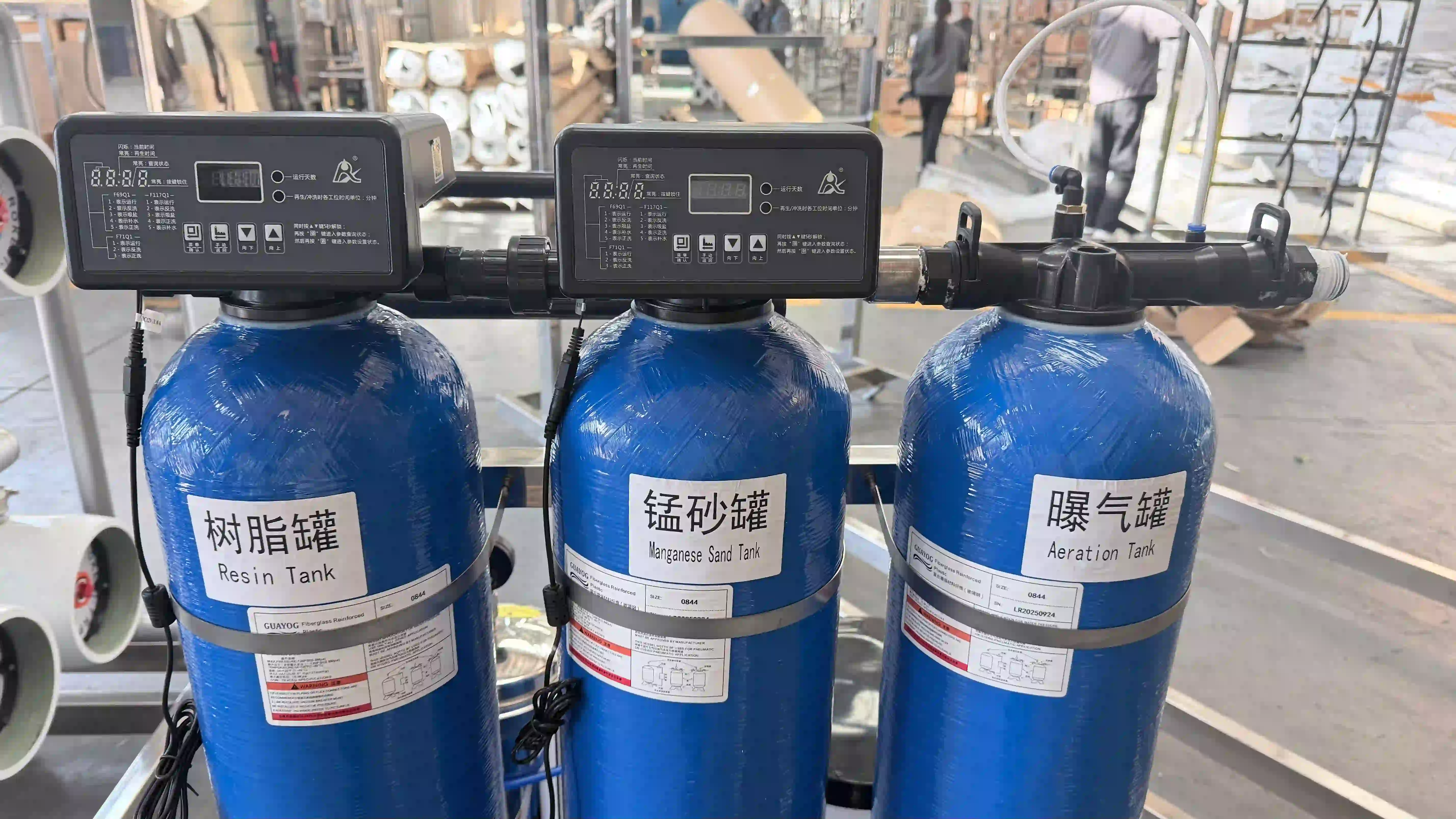
Industrial Manganese Removal from Water for RO Pretreatment
Industrial manganese removal typically combines oxidation with filtration. Oxidation converts dissolved manganese (Mn²⁺) into solid manganese oxides, which a filter can capture. Catalytic media can also adsorb dissolved manganese and promote oxidation within the filter bed. For reverse osmosis (RO) pretreatment, the objective is to control both manganese carryover and residual oxidant at the membrane inlet.
Why Is Manganese Harder to Remove Than Iron?
Low-oxygen well water can contain dissolved manganese even when it looks clear. As manganese oxidizes, it can form dark deposits that stain process equipment and foul RO membranes. Under typical groundwater treatment conditions, manganese oxidizes more slowly than iron. An aeration and filtration system that removes iron successfully may still leave dissolved manganese in the treated water. Strong oxidants can also produce fine colloidal manganese oxides that are difficult to capture.
The operating pH depends on the oxidant, contact time, water temperature, alkalinity, and filter media. Direct oxidation with air or free chlorine generally proceeds slowly near neutral pH, while chlorine can support manganese removal on suitable catalytic media under different operating conditions.
Which Manganese Removal Method Fits Your Water?
Method | When to consider it | What to verify |
|---|---|---|
Chemical oxidation followed by filtration | Dissolved manganese needs to be converted to solids before a downstream filtration stage. Potassium permanganate, sodium hypochlorite, and ozone are options, depending on the process. | Test oxidant demand, pH, contact time, residual oxidant, and how readily the resulting particles can be filtered. |
Catalytic manganese dioxide filtration | A pressure filter is being designed for well water with dissolved manganese, including projects that also need iron removal. | Match the media to the feedwater and oxidant strategy. Check backwash flow, pressure drop, and treated-water manganese. |
Biological filtration | The source water and operating schedule can support an established manganese-oxidizing biofilm. | Assess dissolved oxygen, pH, startup time, and performance under the expected range of source-water conditions. |
Catalytic media, including manganese dioxide-coated media and selected manganese dioxide ores, can adsorb dissolved manganese and promote oxidation on the media surface. Backwashing removes accumulated solids. Media selection also depends on the available backwash flow and how much iron the same filter will need to handle.
How Do You Protect RO Membranes from Manganese?
A typical well-water pretreatment train may include:
Raw water → pH adjustment and oxidant dosing as needed → contact stage where required → catalytic filtration → residual oxidant control as needed → cartridge filtration → RO.
DuPont’s FilmTec™ RO/NF technical manual lists 0.05 mg/L manganese as a maximum feedwater guideline at the membrane inlet. Confirm the project target with the supplier of the selected membrane and verify it on a sample taken after the final pretreatment stage. Where an oxidant is used, also verify that its residual meets the membrane supplier’s requirements. DuPont recommends removing residual free chlorine before it reaches FilmTec™ membranes.
Manganese Removal FAQ
Can a standard cartridge filter remove dissolved manganese?
A standard sediment cartridge captures particles. Dissolved manganese generally requires oxidation and filtration, adsorption on catalytic media, or another treatment step designed to remove dissolved manganese.
Can one system remove both iron and manganese from well water?
Yes. A combined oxidation and catalytic filtration system can treat both. If the iron loading is high, a separate upstream iron-removal stage may be appropriate. The choice depends on the raw-water analysis, oxidant demand, and solids loading on the filter.
What test results are needed to size a manganese removal system?
Start with raw-water results for total and dissolved manganese, iron, pH, alkalinity, and turbidity. Include water temperature and report hydrogen sulfide or ammonia if detected. Provide the design flow rate, daily operating hours, intended water use, and downstream RO membrane model or feedwater requirements if available.
Request a Manganese Removal System Design
From the freezing winters of Canada to the arid mining regions of Australia, QJ Water Treat provides custom manganese removal systems designed for harsh local conditions.
QJ Water Treatment designs and manufactures chemical dosing skids, catalytic pressure filters, and integrated RO pretreatment systems. Send us your raw-water report, required treatment capacity, and treated-water target. We can use that information to propose a process and identify where bench or pilot testing would help confirm performance.